News (9)

Oil & Gas in 2026: Security, Technology and Resilience
08-10-2026
The current Gulf disruption is shifting attention from simple production growth toward resilient infrastructure and secure product supply. A market shaped by disruption Oil and gas markets in 2026 are being driven as much by logistics, refining capacity and geopolitical risk as by crude production itself. By early October, Gulf oil flows recovered substantially from their wartime lows, but total regional exports remained below pre-war levels and refined-product exports recovered more slowly than crude. Brent crude was trading around $100 per barrel, reflecting continuing risk around shipping and infrastructure. The investment priority is resilience For producers and governments, the strategic focus is increasingly on resilient production and processing systems: associated-gas capture and treatment, crude and gas separation, compression, pipelines, storage, alternate export routes, digital monitoring, predictive maintenance, cybersecurity and energy-efficient processing. Projects that reduce flaring, improve recovery, lower operating costs or protect continuity of supply can remain valuable even in a volatile price environment. Technology must be matched to local conditions Oil and gas investments should be based on reservoir and feedstock characteristics, infrastructure availability, market demand, product specifications, environmental obligations and realistic operating capabilities. Technology selection should therefore follow technical and commercial analysis rather than adopting a standard solution for every field or facility. Experts Group perspective Experts Group can support oil and gas clients through Project Development & Management, feasibility and market studies, technology evaluation, EPC Contracting, Trading, Supply & Procurement, Operation & Maintenance, Consultancy Services and Training & Capacity Building. Particular value can be created by integrating engineering, commercial analysis, procurement and project management into one coordinated development process. Sources: Reuters energy-market reporting, October 2026; EIA Short-Term Energy Outlook, October 2026.

Small and Modular Refineries: A Practical Route to Local Fuel Security?
08-10-2026
Current shortages of diesel and other refined products have renewed interest in smaller, faster-to-deploy refining solutions. Why the subject is returning The 2026 energy shock has exposed a major weakness in the global oil system: crude oil can be available while refined products remain scarce. Industry executives have warned of a multi-million-barrel-per-day shortage of refined products, while existing refineries in several markets are operating at very high utilization. This has strengthened the case for additional local processing capacity in countries that produce crude oil but import gasoline, diesel or other products. Where a small refinery can make sense A small or modular refinery can be attractive where there is secure crude feedstock, a defined local products market, expensive imports and limited logistics infrastructure. Modular construction can shorten site work and allow capacity to be developed in phases. However, a simple topping unit is not automatically a complete solution: meeting modern gasoline, diesel and sulfur specifications may require hydrotreating, reforming, sulfur recovery and other upgrading units. Feasibility must come before construction The correct refinery configuration depends on crude assay, required product slate, local specifications, utility availability, storage, transport, environmental requirements, CAPEX, OPEX and expected refining margins. Small refineries also face weaker economies of scale, so the commercial case must be tested carefully. Sometimes, upgrading an existing refinery or building selected processing units may be more economic than constructing an entirely new facility. Experts Group perspective Experts Group can develop the feasibility study, market analysis, crude and product assessment, preliminary configuration, project cost estimate and implementation strategy. We can then support Project Development & Management, EPC Contracting, equipment procurement, commissioning, Operation & Maintenance, Consultancy Services, Training & Capacity Building and financing arrangements. The objective should be a refinery-sized and configured for the local market, not simply a smaller version of a large complex refinery. Sources: Reuters, October 2026, on refined-product shortages and constrained refining capacity; EIA refinery capacity and utilization data.

Italy Renewable Energy Investment Opportunities
08-10-2026
Italy is combining rapid solar growth, new storage mechanisms and major transmission investment with ambitious 2030 targets. Italy is a fast-growing renewable energy market. Italy’s renewable build-out accelerated strongly through 2025 and 2026. Terna reported 81.7 GW of renewable capacity at the end of 2025, including 43.7 GW of solar and 13.5 GW of wind. By July 2026, installed renewable capacity had reached about 87.7 GW, including 47.3 GW of solar and 14.0 GW of wind. Italy’s national pathway points toward 107 GW of solar and wind by 2030. Investment is extending beyond generation Terna’s 2025–2034 grid plan foresees more than €23 billion of transmission investment, while storage is becoming increasingly important. Around 12 GW was contracted through FER X mechanisms in 2025 and Terna reported an 11.1 GW ready-to-build renewable pipeline as of January 2026. Opportunities therefore include solar, agrivoltaics, wind, repowering, battery storage, hybrid projects and acquisition of permitted or ready-to-build developments. The challenge is project quality Italy has a very large connection-request pipeline, which means not every project will reach construction. Investors should focus on permitting quality, grid position, land control, local constraints, expected energy yield, route-to-market, construction cost and the credibility of the development schedule. Due diligence is particularly important when acquiring projects from third-party developers. How Experts Group can support investors Experts Group can assist investors with opportunity screening, feasibility studies, market analysis, technical and commercial due diligence, Project Development & Management, EPC Contracting strategies, procurement, Operation & Maintenance planning and financing support. We can also help compare acquisition opportunities and determine whether a project is genuinely ready to build, requires further development or should be rejected before significant capital is committed. Sources: Terna statistical data and 2025 Development Plan; Terna 2025 results and 2026 monthly updates; Italian PNIEC targets.
Oil Price Outlook to End-2027: Two Scenarios for the Gulf Conflict
08-10-2026
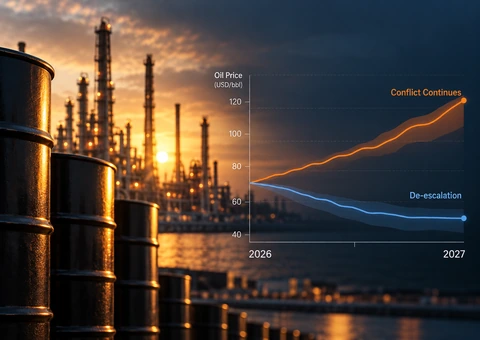
Brent crude settled near $100 per barrel on October 7, 2026. The latest U.S. Energy Information Administration outlook, completed before some of the most recent market events, forecasts Brent to average about $84 per barrel in 2027 as oil flows recover and inventories rebuild. That figure provides a useful de-escalation benchmark, but the current conflict creates unusually wide uncertainty. Conflict and recurring disruption If attacks on shipping and energy infrastructure continue, logistics remain constrained and refined-product shortages persist, Brent could remain broadly in the $95–115 per barrel range during much of 2027. The upper end would become more plausible if export infrastructure suffers renewed damage or the Strait of Hormuz is repeatedly disrupted. High refining margins and tight diesel supply could also keep the wider energy market under pressure. De-escalation and recovery If the Gulf conflict de-escalates, tanker traffic normalizes, damaged infrastructure is restored and inventories rebuild, Brent could gradually fall toward the $75–85 per barrel area by late 2027. This path is broadly consistent with the EIA’s current $84 annual-average forecast, although the decline may be uneven because rebuilding crude and refined-product stocks could take time. Business implication Investors should test projects against both price environments rather than relying on one forecast. Experts Group can incorporate scenario analysis into feasibility studies, project economics, sensitivity analysis, financing models and investment decisions for oil, gas, refining and energy projects. Brent prices are likely to remain highly sensitive to security in the Strait of Hormuz, refinery recovery and the rebuilding of global inventories. Note: The two scenario paths are illustrative midpoints designed for project sensitivity analysis. They are not trading advice or guaranteed forecasts. Sources: EIA Short-Term Energy Outlook, October 6, 2026; Reuters oil-market reporting, October 5–7, 2026; World Bank Commodity Markets Outlook, April 2026. Scenario lines are illustrative Experts Group analysis, not a guaranteed forecast.

UK Renewable Energy Investment Opportunities
08-10-2026
The UK Clean Power 2030 Action Plan points to a major build-out of renewable and flexible capacity. By 2030, the government’s capacity ranges include 43–50 GW of offshore wind, 27–29 GW of onshore wind, 45–47 GW of solar and 23–27 GW of battery capacity. The plan estimates that clean power could require roughly £40–50 billion of investment per year between 2025 and 2030, including generation and transmission infrastructure. Where opportunities are emerging Opportunities include utility-scale and distributed solar, onshore and offshore wind, battery energy storage, long-duration storage, grid-support projects, repowering, co-located renewable-plus-storage projects and acquisition of development-stage or ready-to-build assets. The Contracts for Difference program continues to provide long-term revenue support, while connection reform is prioritizing projects that are deliverable and aligned with system needs. What investors must assess The market is attractive, but project selection is critical. Investors must consider land rights, planning status, grid connection, curtailment risk, technology choice, construction cost, offtake strategy, financing, merchant exposure and operating performance. A project that appears attractive on headline capacity may be weak if its grid or planning position is uncertain. How Experts Group can support investors Experts Group can help investors identify and screen opportunities, conduct feasibility studies and market analysis, review technical and financial assumptions, undertake Project Development & Management, support acquisition due diligence, prepare EPC Contracting strategies, arrange Trading, Supply & Procurement, develop Operation & Maintenance plans, provide Consultancy Services and support financing discussions. This enables investors to move from opportunity identification to ownership and execution with a structured technical and commercial process. Rapid capacity expansion, grid reform and long-term support mechanisms are creating a large pipeline of investable projects. Sources: UK Department for Energy Security and Net Zero, Clean Power 2030 Action Plan; NESO connection reform updates, 2025–2026; UK CfD Allocation Round 7 results, 2026.

Baltic Power: Poland's First Offshore Wind Farm Reaches a Major Milestone
08-10-2026
A landmark project for Poland of a 1.1 GW project in the Baltic Sea illustrates how offshore wind is expanding into new European markets. In October 2026, Northland Power and ORLEN completed installation of all 76 wind turbines at the 1.1 GW Baltic Power offshore wind project. The development is Poland’s first offshore wind farm and is expected to begin commercial operations in 2026, marking a major step in the country’s transition toward a more diversified and lower-carbon electricity system. Why the project matters Baltic Power demonstrates that offshore wind is no longer concentrated only in the mature North Sea markets. New countries are building supply chains, port capabilities, grid connections and specialized engineering capacity around offshore wind. For investors, this creates opportunities not only in project equity but also in electrical infrastructure, marine services, operations and maintenance, component supply and long-term technical support. Lessons for project developers Large renewable projects require much more than a good energy resource. Successful delivery depends on permitting, grid connection, bankable offtake, financing, engineering, procurement, construction interfaces and long-term operating plans. Offshore projects add marine logistics, weather risk, specialist vessels and complex supply-chain coordination. Experts Group perspective Experts Group can support renewable-energy investors by evaluating project opportunities, carrying out feasibility and market studies, reviewing technical and commercial assumptions, coordinating Project Development & Management, supporting EPC Contracting and procurement strategies, and planning Operation & Maintenance. Similar methodologies can be applied to offshore wind, utility solar, onshore wind and hybrid generation-plus-storage projects in Europe and other markets. Sources: Reuters, October 7, 2026, on completion of turbine installation at Baltic Power; project/company public information.

Renewable Energy in 2026: Global Growth Enters a New Phase
08-10-2026
Solar, wind and battery storage are moving from supporting roles to the core of power-system growth. A structural shift in global power The global electricity transition reached a major milestone in 2025. Renewables supplied 33.8% of global electricity and overtook coal for the first time in the modern power system. Solar was the main driver: global solar generation increased by 30% in one year, while a record 647 GW of new solar capacity was added. Solar alone met about three-quarters of the increase in global electricity demand. Storage is changing the value of solar The next phase is not simply about installing more renewable capacity. Battery storage is increasingly being deployed alongside solar and wind to move electricity from periods of high output to periods of higher demand. Ember estimates battery deployment grew to about 250 GWh in 2025 while battery costs fell sharply, improving the economics of hybrid solar-plus-storage projects and reducing curtailment. What does this mean for investors The opportunity is to broaden from stand-alone generation to integrated energy systems: solar, wind, battery storage, grid reinforcement, digital control, demand flexibility and long-term power purchase structures. The strongest projects will be those that combine good resource quality with grid access, bankable revenue arrangements, realistic construction schedules and a clear operating strategy. Experts Group perspective Experts Group can support investors and project owners through Project Development & Management, feasibility and market assessment, technical and commercial evaluation, EPC Contracting, Trading, Supply & Procurement, Operation & Maintenance, Consultancy Services, Training & Capacity Building and financing support. The objective is to turn an attractive renewable-energy concept into a technically sound, commercially viable and executable project. Sources: Ember, Global Electricity Review 2026 (April 2026); Experts Group analysis.

Protecting Patient Data in UK
30-05-2026
StegoTime provides an excellent, simple, flexible solution to protect your patient data, while it is stored on your computer, local server, or cloud; or while it is exchanged across the Internet. Simpley, use Stegotime to hide the patient data in an image of your choice (e.g., your patient photo), authroize your patient or any other person who is legally authroized to access this data, and store it or send it to them by email. You can be sure that no one can disclose the data except you, your paient, and those whom you authroized. As a doctor you have an ethical, legal and contractual duty to protect patient confidentiality. Under data protection law, those responsible for patient data are legally obliged to store it securely and protect it from unauthorized or unlawful processing. The General Medical Council (GMC) guidance on confidentiality states that “you must make sure any personal information about patients that you hold or control is effectively protected at all times against improper access, disclosure or loss”. You must make sure that identifiable patient data is not improperly disclosed in any circumstances. An inadvertent breach of patient confidentiality could result in you facing patient complaints or even a trust disciplinary or GMC investigation. Communicating via Mobile Apps NHS guidance for doctors using mobile apps which lack proper security features – such as WhatsApp – advises that “it should never be used for the sending of information in the professional healthcare environment.” The guidance warns that, as a consumer service, WhatsApp “does not have a service level agreement (SLA) with users and has no relevant data security certification” and, as such, should not be used to send patient information or details of clinical cases to colleagues. Data Storage on Portable Devices When used with care, portable storage devices are a valuable and convenient way to store and transfer data. However, since mobile devices are particularly vulnerable to loss or theft, security and best practice should be your first priority. Avoid storing identifiable personal data on personal mobile devices, such as memory sticks, laptops or personal mobile phones, which risk being misplaced or accessed by other people. Familiarise yourself with your trust's information security policy and the name of the person in charge of data security. Always follow trust procedures on the use of mobile devices, laptops and portable data storage. If you are worried about whether you should use a portable storage device at work, talk to your trust information officer for advice. Encryption and password protection of data held on mobile devices would be considered to be standard practice. Make sure you only transfer or store information in line with your trust's information security policies, and take care not to mix professional and personal data. There can be particular dangers where doctors use the same devices for both professional and personal use. Follow relevant GMC and NHS guidance and get to know your legal requirements under data protection law. If you lose any data, report the incident to the nominated senior person in your organisation immediately. They can then take appropriate action and inform patients, if necessary.
DoD Applications of Steganography
30-05-2026
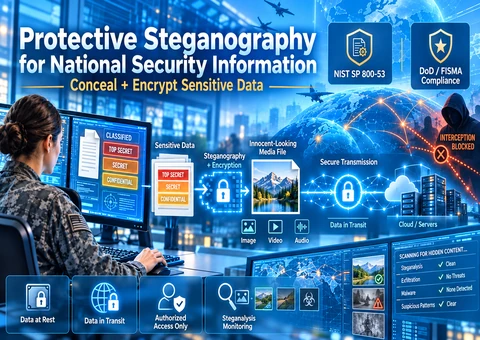
Department of Defense Applications of Steganography The U.S. Department of Defense (DoD) is mandated to follow the National Institute of Standards and Technology (NIST) Special Publication (SP) 800–53 to be compliant with the Federal Information Security Management Act (FISMA) of 2002, in which the most current version, Revision 4, serves as a Risk Management Framework (RMF) which contains a list of over eight-hundred unique security controls that federal organizations are required to implement to varying degrees depending on the risk categorization of their particular information system. There are several other NIST and DoD publications that complement the SP 800–53, however, this publication is the sole reference source for NIST security controls. With NIST’s SP 800–53 revision 4, it specifically addressed for the first time ever the dangerous threat of steganography. Specifically, the SC-7 boundary control security control, addresses monitoring for steganography; the malicious code protection security control, SI-3, addresses malicious code possibly hidden in files using steganography; and the SI-4 enhancement (18), addresses covert means that can be used for unauthorized exfiltration of organizational information. The U.S. Department of Defense (DoD) is mandated to incorporate digital steganography to protect National Security Information (NSI). It makes practical sense to apply a high level of security as is both feasible and possible on National Security Information (NSI) due to the fact that if this sensitive information were to come into the possession of adversaries, it could potentially cause grave damage to U.S. national security. It is logical then to apply the strongest forms of security controls to protect this information. One advantage of steganography is that it allows users to both cloak and encrypt data into cover mediums such as images, video and audio files, voice over Internet Protocol (VoIP) data, and many other types of digital media. In order for it to be effectively used, the NSI data could be hidden using steganography while the data is at rest, but especially when the data is in transit across networks. When NSI data is being copied to any type of media, it is required to be encrypted but could also be hidden using steganography. The added protection would make it so much more difficult for adversaries to locate NSI data, and if it were somehow spotted they would need to find the appropriate steganography application to attempt to open the file with the correct passphrase and crack the encryption. There would be a learning curve that would need to occur for all federal employees, military personnel, and DoD contractors who have access to NSI data in order to properly educate personnel on how use steganography applications and proper encryption methods and passphrase creation. However, this slight measure of pain would ensure that America’s most sensitive information is well-protected and if it were intercepted by adversaries, it would be nearly impossible for an adversary to read it. National Security Information (NSI), also known as classified information, as defined by Executive Order 12356 as being classified at three different levels as either top secret, secret, or confidential information that could be expected to cause gravedamage, serious damage, or a level of damage to national security respectively. Ronald Reagan, Executive Order 12356, 2nd April 1982. Intelligence Community Applications of Steganography The Intelligence Community uses cryptography almost by default to protect sensitive NSI. Cryptography systems are generally either symmetric with a single key or asymmetric with both public and private keys for decrypting messages. When encryption is employed in messages or data it raises suspicion by adversaries who could potentially be remotely monitoring network data packets and it’s a dead giveaway that at least some type of sensitive information is included within packets. Using cryptography openly may serve to compel adversaries to try even harder to decipher encrypted data. However, steganography is not detectable and does not raise suspicion unless it is specifically being checked for with special steganalysis software application tools and even then it is possible that if discovered, the secret message stego file will not be able to be decrypted and readable. Advanced Persistent Threat (APT) groups are often named by a numerical value and sometimes also associated with the name the malware the group uses. The “Stuxnet” virus was by far the most sophisticated digital warfare weapon ever conceived and has been confirmed by President Obama to have been developed cooperatively between the U.S. and Israel to thwart the Iranian efforts to enrich Uranium for nuclear weapon manufacturing. While steganography was not discovered within the complex bundles of code used in the Stuxnet virus, other forms of malware have incorporated steganography into the code to mask the exfiltration of sensitive proprietary, classified, personal and financial data. U.S. officials discovered that in 2010 a Russian spy ring located in the U.S. was utilizing “Duqu” and “Alureon” malware to exfiltrate classified U.S. NSI back to Russia using steganographic techniques to hide their payloads (Wendzel et al., 2014, p. 2). It is relatively safe to assume that government spy agencies like the National Security Agency (NSA) and the Central Intelligence Agency (CIA) have also used digital steganography by this point in time. Predictable Adversarial Response to Protective Steganography Use If a country such as the U.S. were to begin utilizing digital steganography to protect NSI, assuming it is not already doing so, the predictable adversarial response would be an increase in steganalysis tools designed to detect steganography file signatures combined with cryptanalytic software tools designed to break and decrypt encrypted data. State and non-State actors would also begin utilizing steganography if it was not already being employed to protect their own sensitive information. Essentially, the use of steganography will only result in nuclear détente situation that serves to elevate the level of sophistication that nations will have to ascend to in order to protect their NSI. In other words, if every country has nukes or uses digital steganography to protect NSI, then there is little value in having or using these types of weapons. Employing digital steganography combined with strong encryption does not assure secrecy any more than employing highly-compensated cybersecurity professionals does not assure an organization will never be hacked. What it does do, however, is make it much more difficult for adversaries to intercept and decrypt secret messages. For that reason, it does make practical sense for the U.S. government to implement some measure of “protective” steganography to better protect its most sensitive data. Conclusion In conclusion, digital steganography can be a very effective and affordable means of further protecting NSI beyond traditional encryption methods to conceal its existence altogether. It may not be worth training the massive amounts of U.S. government, military, and contractor personnel on how to properly use steganography applications to hide data in transit, but perhaps the cost and hassle would be justified only for Top Secret-level or above NSI. There is absolutely no reason that digital steganography has to only be used by the malicious actors online. There is a valid case to be made for the U.S. government to direct the implementation of digital steganography combined with strong encryption and passphrases to further protect its most sensitive information. It is all but guaranteed that America’s adversaries like Russia, China, Iran, and North Korea have implemented digital steganography into their cyber weapon arsenal, and perhaps the U.S. has secretly done so as well. If the U.S. has incorporated digital steganography to protect NSI then it is on the right track, however, if it has not then it is walking a dangerous line by not utilizing this great form of protection. Source: Using Digital Steganography to Protect National Security Information by z3roTrust, Nov 26, 2018